
Berkshire Beyond Buffett

It was a surprise speech.
A few weeks ago some friends and I attended the Berkshire Hathaway annual meeting. It was to be the first meeting not led by it’s founder and chairman Warren Buffett, who last year turned over the CEO role to his long-time lieutenant Greg Abel.
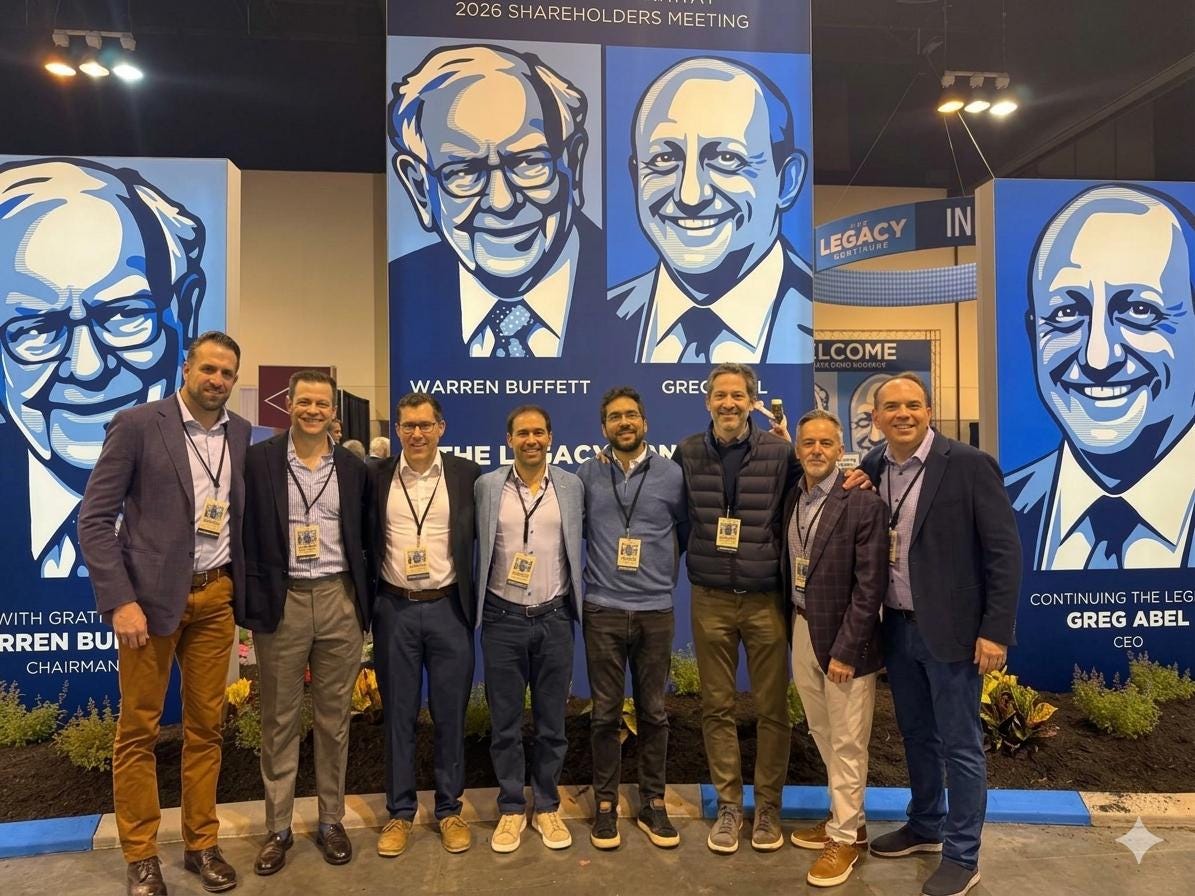
(That’s me on the right)
We weren’t expecting to hear anything from the legendary Oracle of Omaha, but a few minutes into the meeting Abel got a mic to Buffett, age 95, who was sitting in the front row. The crowd went wild.
Buffett, wearing a sweater instead of his typical dark suit, reflected on how this year marked several anniversaries: Berkshire Hathaway’s 60th, Apple Computer’s 50th, and the 10th anniversary of Berkshire’s investment in Apple.
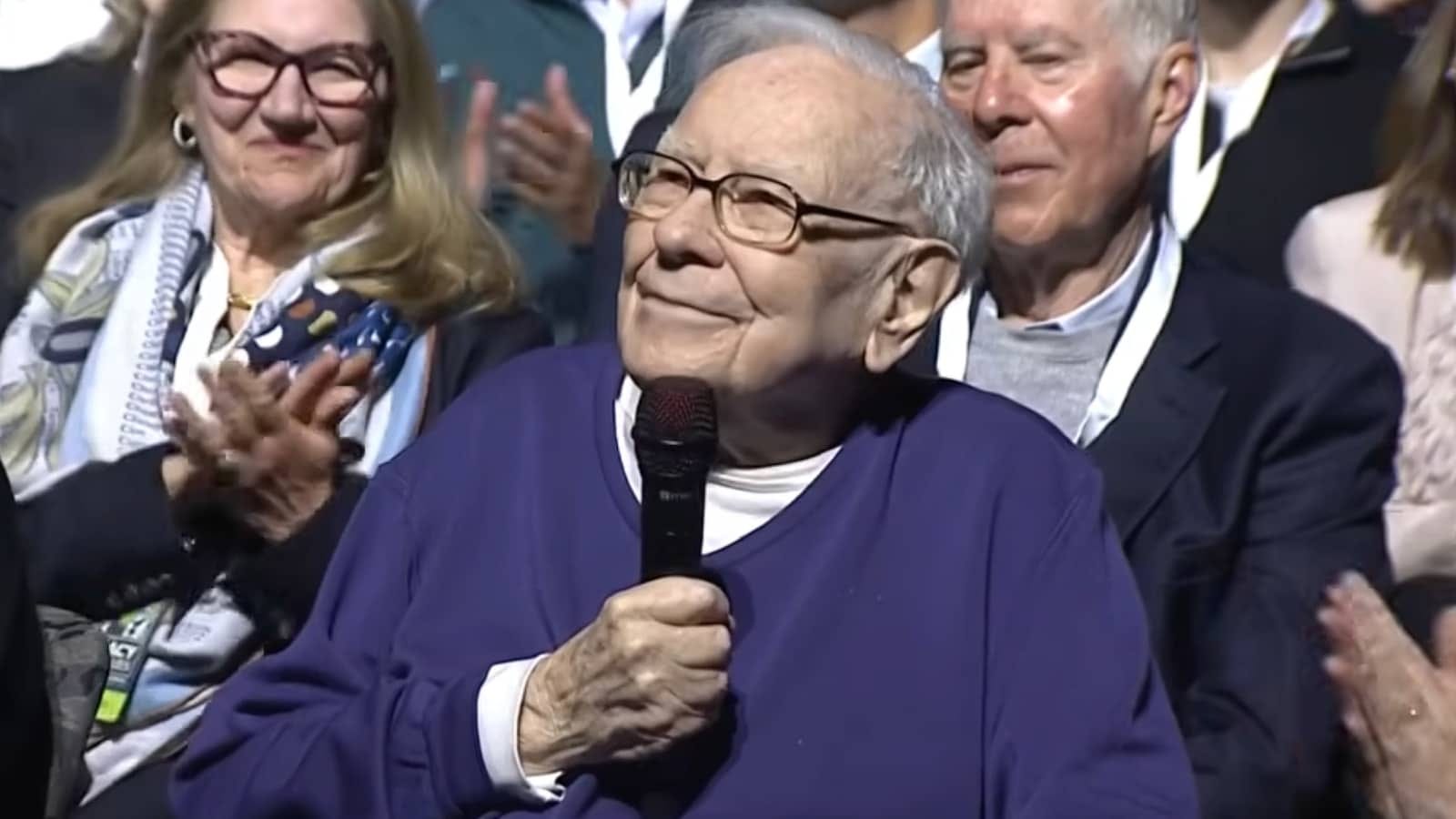
It was a big investment: $35 billion, roughly 10% of Berkshire’s resources at the time. Buffett, in his classic aww shucks style, said they had turned that money over to the management of Apple to make Berkshire look good, without any work by us, “which is our preferred way of operating.”
It was a very good decision. In the time since then, that $35 billion has grown to $185 billion in value and, Buffett said with a grin, “I didn’t have to do a damn thing.”
Tim Cook, who has led Apple as CEO during the time of Berkshire’s investment, recently announced his own retirement. Buffett suggested that the Berkshire shareholders, who had benefitted to much from Cook’s success ought to thank him. Then in a surprise move, he said Tim was there and asked him to stand up. Lo and behold, a few rows behind Buffett, Tim Cook, CEO of one of the world’s most valuable companies, gamely rose and waved to the crowd.
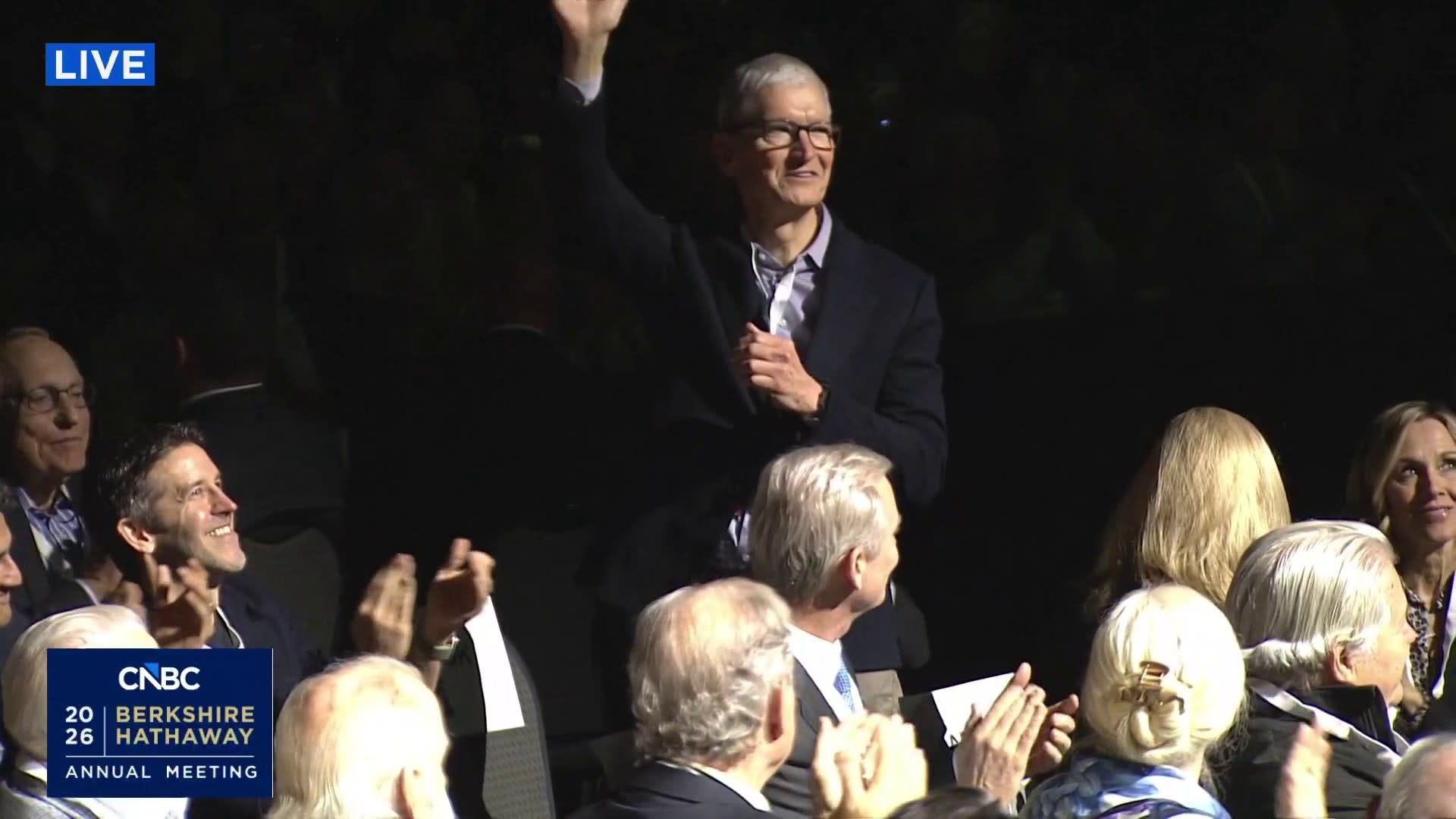
Buffett went on to share that when Steve Jobs died, everybody in America knew his name. Tim Cook succeeded him “and not many people knew his name.” And yet, Buffett says Cook “made Berkshire a lot more money than I ever made” for Berkshire Hathaway.
Buffett’s words and tone were gracious and grateful. They were also dripping with additional meaning given the setting of the meeting. Buffett is himself a nationally-known figure and very few people know his successor Greg Abel. But, without saying it directly, Buffett suggested the perfect parallel to give investors confidence in a post-Buffett Berkshire.
Woodstock for Capitalists
The Berkshire Hathaway annual meeting is unlike any other shareholder meeting I’ve heard of. At its peak, it drew more than 40,000 attendees who would sit in a basketball arena (and in satellite viewing rooms if they didn’t arrive early enough to get an arena seat) to listen for hours to two old guys (Buffett and his Vice Chairman Charlie Munger), who somewhat resembled Statler and Waldorf from the Muppets, answer questions from the audience about everything from the macroeconomy to subsidiary operations to life advice.
Why did it work? A big part of the reason is that Buffett and Munger were darn smart. Buffett is known as the world’s greatest investor for a reason. In the 60 years he led Berkshire, he returned 6,000,000%, beating the S&P 500 by a factor of 130. Those wanting an education in business could do worse than listening to recordings of those Q&A sessions over the years. They could also do worse than by reading Buffet’s 60 years of annual letters. In those letters, Buffet shared at length about the performance of the company, the lows as well as the highs. But he didn’t just share about the performance, he shared about his philosophy and approach to investing. He shared what made Berkshire work so well, and also what he learned from his failures. His model has influenced my own nascent habit of writing annual letters for Saturn Five.
In preparation for attending the Berkshire meeting, I read two books suggested by my friend Chris: The Warren Buffett Way by Robert Hagstrom and The Essays of Warren Buffett, edited by Lawrence Cunningham. The latter is a thematically organized collection from Buffett’s annual letters. Reading them felt like being mentored, given my day job. I understand there is now a new compendium of all of Buffett’s annual letters (which you can also access for free on the Berkshire website). I’ve also read Alice Schroeder’s exhaustive and entertaining biography, Snowball: Warren Buffett and the Business of Life. For the best introduction to Buffett without getting overwhelmed, I’d suggest the volume by Cunningham.
Another reason the Annual Meeting became such a draw was simply that Buffett and Munger were tremendously entertaining. They didn’t take themselves to seriously and they knew how to tell a joke. They had what the kids call “rizz.”
This year attendance at the Berkshire meeting, led for the first time by Greg Abel, was about half of what it was last year. Abel is clearly intelligent and is a strong operator, but as the face and voice of this iconic company, he lacks the humor and winsomeness that defined Buffett and Munger. An example:
What happens to Berkshire Now?
Standing at a market cap of more than a trillion dollars, Berkshire Hathaway is still one of the most valuable companies in the world. Berkshire has nearly $400 billion in cash on its balance sheet compared with only $128 billion in debt. Buffett is still chairman, but even when he eventually passes on, Berkshire won’t be going anywhere anytime soon.
Every business founder casts a shadow that long outlasts them and Buffett’s shadow will be longer than most. Can Abel step into the light on his own? Part of the answer might be that he’s not trying to do it on his own. Breaking with tradition, Abel had subsidiary CEOs BNSF Railway’s Katie Farmer and NetJets’ Adam Johnson join him on the podium to answer questions.
Investor Vitaly Katsnelson argues that Abel is likely going to be a better CEO of Berkshire at this point that Buffett would have been:
BRK requires three skill sets today. The first is replacing Ajit Jain, who will be very difficult to replace. The new CEO's job is to make sure the right people are running that business. The second is running the rest of the BRK portfolio of private companies, and this is where BRK needs the most help. Buffett was never a traditional CEO. He loved investing (capital allocation), not managing people, and he avoided conflict at all costs. He bought businesses, let managers run them, collected the cash flows, and reinvested them. Today BRK has a collection of more than 100 operating businesses. BNSF and GEICO are the ones that matter most, and both have become hallmarks of mediocrity…
BRK has reached a size where, absent a real financial dislocation, capital allocation is unlikely to be the source of forward returns. The low-hanging fruit is improving the performance of BRK's core holdings, and maybe even shedding companies that shouldn't be in the BRK portfolio. Greg, a billionaire and a large shareholder of BRK, has proven to be a shrewd operator of BRK's energy business. Choosing Greg is one of the most important decisions Buffett made in decades. At the last annual meeting, we could see why. A corporate Mr. Fix-It is walking through every business, identifying key performance indicators, installing the right incentives, bringing technology to them, and replacing managers who need replacing. Doing things Buffett could not and would not do, but that need to be done.
Why do Berkshire and Buffett matter?
Regular readers of The Weekend Reader may wonder why, when I’ve recently been writing more about AI and tech and culture, would I spend an entire edition on a 95 year-old investor and his succession. Admittedly the topic may hold more interest for me than for many. But I think Buffett and Berkshire have been significant symbols of a type of capitalism that many have forgotten and that too few seek to emulate.
Buffett built his legacy not just through genius investing, but through developing a reputation for doing business the right way.
After all, it was Warren Buffett who defined business ethics for a generation when he took control of Solomon Brothers as Chairman and CEO after the bank nearly went under due to a trading scandal. He could have downplayed the problems. Instead he called the bank’s employees to a higher standard, demanding they act as their own compliance officers. He told them to use a simple test, imagine that any action they might take would appear the next day on the front page of their local newspaper read by their wife, children and friends, with the reporting done by an informed and critical reporter. Buffett then gave the chilling warning to the bankers:
“Lose money for the firm and I will be understanding. Lose a shred of reputation for the firm, and I will be ruthless.”
I remember being taught this story in my MBA business ethics class, as an example of what having a moral backbone looked like as a leader.
Buffett also took stands that made sense, even though they were against his own self-interest. I don’t know many billionaires today who say their tax rate is too low versus those that work for them. But Warren Buffett caused a stir in 2012 when he called the tax system “outrageous” because his secretary paid effective tax rate twice as high as his. (Her income was subject to payroll and income taxes, pushing her effective rate to 36% while his effective rate was 17% due to the fact that it was nearly all capital gains and had no payroll tax).
Buffett was became a legend for his frugal and unostentatious lifestyle despite owning vast wealth. He never moved out of Omaha. In fact, he never moved from the house he first bought in 1958. He gets breakfast at the same McDonalds every day, paying in cash with exact change. Buffett co-founded The Giving Pledge and plans to give away 99% of everything he has made during his lifetime or at death. He simply enjoyed making money more than he enjoyed spending it.
In his farewell letter, Buffett counseled,
“Greatness does not come about through accumulating great amounts of money, great amounts of publicity or great power in government. When you help someone in any of thousands of ways, you help the world. Kindness is costless but also priceless. Whether you are religious or not, it’s hard to beat The Golden Rule as a guide to behavior.
I write this as one who has been thoughtless countless times and made many mistakes but also became very lucky in learning from some wonderful friends how to behave better (still a long way from perfect, however). Keep in mind that the cleaning lady is as much a human being as the Chairman.
It is not that there aren’t other inspiring business leaders out there. There are many good man and women leading companies all over the country. But few have led at the scale Buffett has led, and none have been doing it in the public eye for so long. Losing Buffett as a capitalist’s moral compass will create a void.
Already, some polls find that a majority of young Americans prefer socialism to capitalism. It’s hard to blame them when they feel the odds are stacked against them, and who doubt they will be better off than their parents. That disillusionment will only be amplified without examples of “good capitalists” like Buffett, who seemed to honestly care about the system being fair for everyone.
Now I don’t admire everything about Buffett. He has had a strange marital relationship and who knows what sacrifices he made with his family to build Berkshire. Buffett wasn’t perfect. He’s the first to admit that. But his ability to admit his imperfections and failures so freely is a big part of what made him different.
Buffett exemplified a midwestern humility and work ethic. He led with self-deprecating humor rather than self-aggrandizing hubris. He read widely, thought deeply, and learned learned from his mistakes, sharing his lessons with those that cared to listen.
We’d likely be better off if we had a dozen leaders who were a little more like Warren Buffett, or even just one or two. That’s why I’m rooting for Greg Abel - not just to continue growing Berkshire’s value, but to continue a legacy of public leadership that has shown us a more excellent way.
Read widely. Read wisely.
- Max
Thank you Max. Great post. I was there too and enjoyed your spot on summary of the experience. As a reader of Buffet shareholder letters, I penned and published my response to his final letter before stepping down. I hope you enjoy it.
https://www.crown.org/all-resources/ask-chuck-an-open-letter-to-warren-buffett-one-lucky-man/